


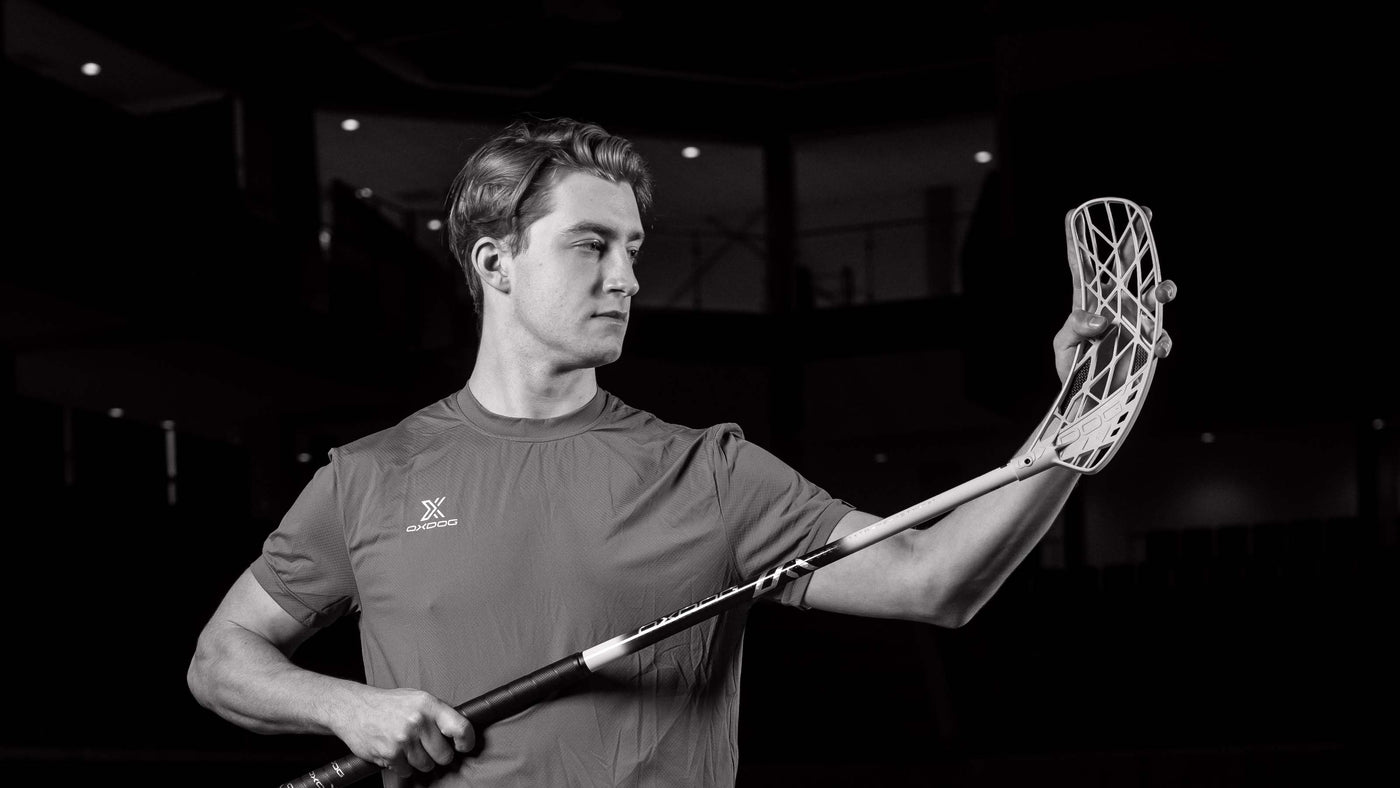
When choosing a blade, three main aspects should be considered: concavity, pre-curve, and material.
Concavity: The deeper the concavity of the blade, the better the ball stays on the blade during stickhandling and deking. A deep concavity (e.g., 9.5 mm) is suitable for goal scorers. A moderate concavity (e.g., 8.0 mm) on the other hand, facilitates backhand play and accurate passes.
Pre-curve: A pre-curved blade helps the ball rise more easily and provides extra power for wrist shots. Straighter blades are favored by playmakers due to their predictability.
Stiffness and Weight: Lightweight blades make the stick blade-light and quick to handle. Stiffer, carbon fiber reinforced blades (MBC/NBC), on the other hand, offer maximum power transfer for hard shots.
MB (Medium Blade)
Medium stiffness material, good durability and overall feel with a soft ball touch.
NB (Normal Blade)
Slightly softer than MB material, the blade surface is harder than MB material. Very smooth gliding material on all playing surfaces.
MBC/NBC (Medium/Normal Blade Carbon)
The blade contains a carbon fiber reinforcement, which makes the blade stiffer without significant added weight. The number of carbon fiber pieces/plates varies from one to three, depending on the blade model.
CPB (Carbon Polymer Blade)
Top material combining carbon fiber and lightweight polymer – for maximum stiffness and lightness.
You can find pre-curved VELHO HOOK blade options in our selection.
VELHO HOOK - VH 1
With maximum concavity and strong toe curve.
VELHO HOOK - VH 2
With a claw-like toe curve that improves ball feel.
Blades can also be curved by heating the blade and curving it to the desired shape. According to the rules, a blade can be curved by a maximum of 3cm.
The blade is a wearing part of the stick. It should be replaced with a new one when:
The blade has loosened: Continuous shooting fatigues the plastic, causing the blade to give way, and shots no longer have the same snap.
The base is worn: When the blade's base is worn thin and sharp, the blade should be replaced with a new one. This is also for safer play.
You want to change your playing style: Sometimes, simply changing the blade from straighter to more curved (or vice versa) can alter your playing and give your stick a whole new life without needing to replace the entire stick.
The blade of a floorball stick is a wearing part, but replacing it is quite simple.
Removing the screws: Unscrew the fastening screws located at the heel of the blade. Keep them safe unless you are replacing them with new ones.
Heating: Gently heat the heel of the blade with a heat gun. The heat will cause the plastic to expand and any glue to soften, making the blade easier to remove. Be careful not to burn the shaft or the blade!
Removal: Pull the old blade off the shaft with a firm motion. If the blade is stuck, try wiggling it gently while pulling.
Installing the new blade: Heat the heel of the new blade for a moment to help it slide into place more easily. Push the blade onto the end of the shaft as far as it goes. Pay attention to the grooves at the base of the blade, which lock the blade into the correct angle. Ensure the blade is straight in relation to the shape of the shaft.
Fastening: Screw the screws back into place. If the new blade is a different model than the old one, you may need to drill new small pilot holes in the stick shaft. New holes in the shaft will not weaken it in any way.
Tip: Always check after replacement that the blade does not move. A securely attached blade ensures the best ball control and safety on the field. If blades have been changed many times on the shaft, it is recommended to use blade glue during installation to keep the blade firmly in place and prevent it from moving. (Old screw holes always enlarge over time, and after that, the glue will hold the blade firmly in place).
